
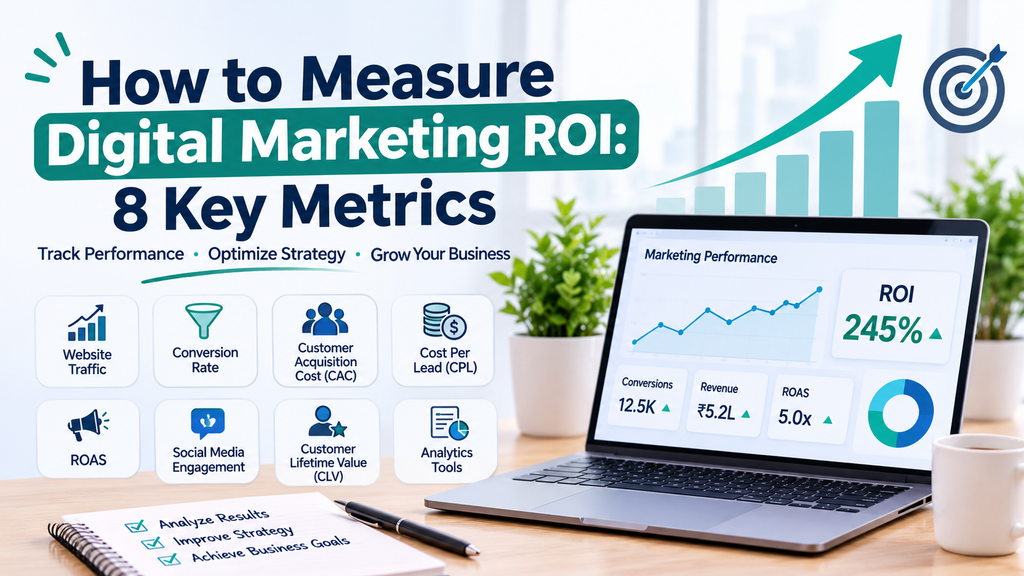
Investing in digital marketing is an important step toward growing a business, but how do you know whether your marketing efforts are actually delivering results? Running advertisements, publishing social media content, and improving website visibility are useful activities, but businesses also need to understand the value they receive from these investments. This is where digital marketing ROI becomes important.
Return on Investment (ROI) helps businesses evaluate whether their marketing activities are generating enough revenue compared to the money spent. By tracking the right performance indicators, companies can identify successful campaigns, improve their marketing strategies, and make better business decisions. With a structured approach from The Wild Click, businesses can focus on measurable outcomes rather than simply counting clicks and impressions.
1. Understand What Digital Marketing ROI Means
Digital marketing ROI measures the financial return generated through marketing activities compared to the amount invested.
It helps businesses understand whether their spending on SEO, social media marketing, paid advertising, and other promotional activities is contributing to business growth.
The basic ROI formula is:
ROI = (Revenue Generated – Marketing Investment) / Marketing Investment × 100
For example, suppose a business spends ₹20,000 on a digital marketing campaign and generates ₹60,000 in revenue.
ROI = (60,000 – 20,000) / 20,000 × 100
ROI = 200%
This means the campaign generated a 200% return on the marketing investment, before accounting for other business costs.
2. Track Website Traffic
Website traffic is one of the basic indicators of digital marketing performance. It shows how many people are visiting your website and provides insights into how audiences discover your business.
Businesses should monitor different traffic sources, including:
- Organic search traffic
- Paid advertising traffic
- Social media traffic
- Direct website traffic
- Referral traffic
Google Analytics 4 can help businesses understand visitor behavior, identify popular pages, and analyze how users interact with their websites.
However, high traffic does not always mean high revenue. It is important to understand whether visitors are relevant to your business and whether they take meaningful actions.
3. Monitor Conversion Rate
Conversion rate measures the percentage of website visitors who complete a desired action.
Depending on your business goals, conversions may include:
- Filling out a contact form
- Making a purchase
- Booking a consultation
- Subscribing to a newsletter
- Requesting a product demonstration
The conversion rate formula is:
Conversion Rate = (Total Conversions / Total Visitors) × 100
For example, if 1,000 people visit your website and 50 submit an inquiry, your conversion rate is 5%.
Monitoring this metric helps businesses understand how effectively their website and marketing campaigns turn visitors into potential customers.
4. Calculate Customer Acquisition Cost (CAC)
Customer Acquisition Cost (CAC) measures how much money a business spends to acquire one new customer.
It is an important metric for understanding the efficiency of marketing campaigns.
The formula is:
CAC = Total Marketing and Sales Costs / Number of New Customers Acquired
For example, if a business spends ₹30,000 on marketing and sales activities and acquires 30 new customers, its customer acquisition cost is ₹1,000.
A lower acquisition cost can improve profitability, provided that the business continues attracting valuable customers.
Businesses should compare CAC across different marketing channels to understand where their investments are working most effectively.
5. Measure Cost Per Lead (CPL)
Cost Per Lead (CPL) helps businesses understand how much they spend to generate one potential customer inquiry.
This metric is particularly useful for businesses that depend on inquiries, appointments, consultations, and service bookings.
The formula is:
CPL = Total Campaign Cost / Number of Leads Generated
For example, if a Google Ads campaign costs ₹10,000 and generates 100 leads, the cost per lead is ₹100.
Businesses can use CPL to compare different campaigns, audiences, and advertising platforms.
However, a low CPL does not automatically mean a successful campaign. Lead quality and the percentage of leads that become paying customers are equally important.
6. Evaluate Return on Ad Spend (ROAS)
Return on Ad Spend (ROAS) measures the revenue generated for every rupee spent on advertising.
It is especially useful for businesses running Google Ads, Facebook Ads, and Instagram Ads.
The formula is:
ROAS = Revenue Generated from Ads / Advertising Cost
For example, if a business spends ₹5,000 on advertisements and generates ₹25,000 in attributed revenue, its ROAS is 5x.
This means the business generates ₹5 in revenue for every ₹1 spent on advertising.
ROAS helps marketers identify which advertising campaigns are performing well and where budget adjustments may be necessary.
Remember that ROAS is not the same as profit. Product costs, operational expenses, and other business expenses must also be considered.
7. Analyze Social Media Engagement
Social media marketing is not only about increasing followers. Businesses should also understand how people interact with their content.
Important engagement indicators include:
- Likes and comments
- Shares and saves
- Video views and watch time
- Profile visits
- Link clicks
- Direct messages and inquiries
These metrics help businesses understand which content attracts attention and encourages meaningful interactions.
For example, a business may discover that educational reels generate more inquiries than promotional posts. This information can help improve its future content strategy.
A consistent approach to social media and content performance, supported by The Wild Click, can help businesses evaluate their online marketing activities more effectively.
8. Monitor Customer Lifetime Value (CLV)
Customer Lifetime Value (CLV) estimates the total revenue a business can expect from a customer throughout their relationship with the company.
It is an important metric because successful marketing is not always about acquiring new customers. Retaining existing customers can also contribute significantly to long-term business growth.
Businesses can improve customer lifetime value through:
- Better customer experiences
- Personalized communication
- Loyalty programs
- Consistent customer support
- Relevant product recommendations
- Follow-up campaigns
Comparing CLV with Customer Acquisition Cost helps businesses understand whether their customer acquisition strategy is sustainable.
9. Use Analytics Tools to Measure Marketing Performance
Tracking marketing performance becomes easier with the right analytics tools. These platforms help businesses collect data, understand campaign results, and identify areas that need improvement.
Some useful digital marketing analytics tools include:
Google Analytics 4: Helps analyze website traffic, user behavior, and conversions.
Google Search Console: Provides information about search performance, clicks, impressions, and website indexing.
Google Ads: Helps track advertising performance, conversion data, and campaign costs.
Meta Ads Manager: Provides insights into Facebook and Instagram advertising campaigns.
Looker Studio: Helps create visual reports and dashboards by connecting different marketing data sources.
Businesses can use these tools to develop a clear picture of their marketing performance. The Wild Click also highlights live reporting and dashboard visibility, helping businesses understand important outcomes such as leads, revenue, and advertising returns.
10. Improve Your Digital Marketing Strategy Using Data
Collecting marketing data is only the first step. Businesses must also use these insights to improve their strategies.
Here are some practical ways to optimize marketing performance:
- Identify campaigns that generate valuable leads.
- Reduce spending on campaigns with consistently poor results.
- Improve landing pages with low conversion rates.
- Focus on marketing channels that attract relevant customers.
- Test different advertising creatives and messages.
- Review campaign performance regularly.
- Set measurable goals for every marketing activity.
A data-driven approach allows businesses to make informed decisions instead of relying entirely on assumptions.
Conclusion
Measuring digital marketing performance is essential for businesses that want to grow sustainably. Metrics such as ROI, conversion rate, customer acquisition cost, cost per lead, ROAS, and customer lifetime value provide valuable insights into the effectiveness of marketing investments.
However, tracking numbers alone is not enough. Businesses must regularly analyze their results, identify opportunities, and improve their strategies based on real performance data.
If you want to make your marketing investments more measurable and build a stronger online presence, explore The Wild Click for digital marketing solutions that bring strategy, execution, and performance tracking together.